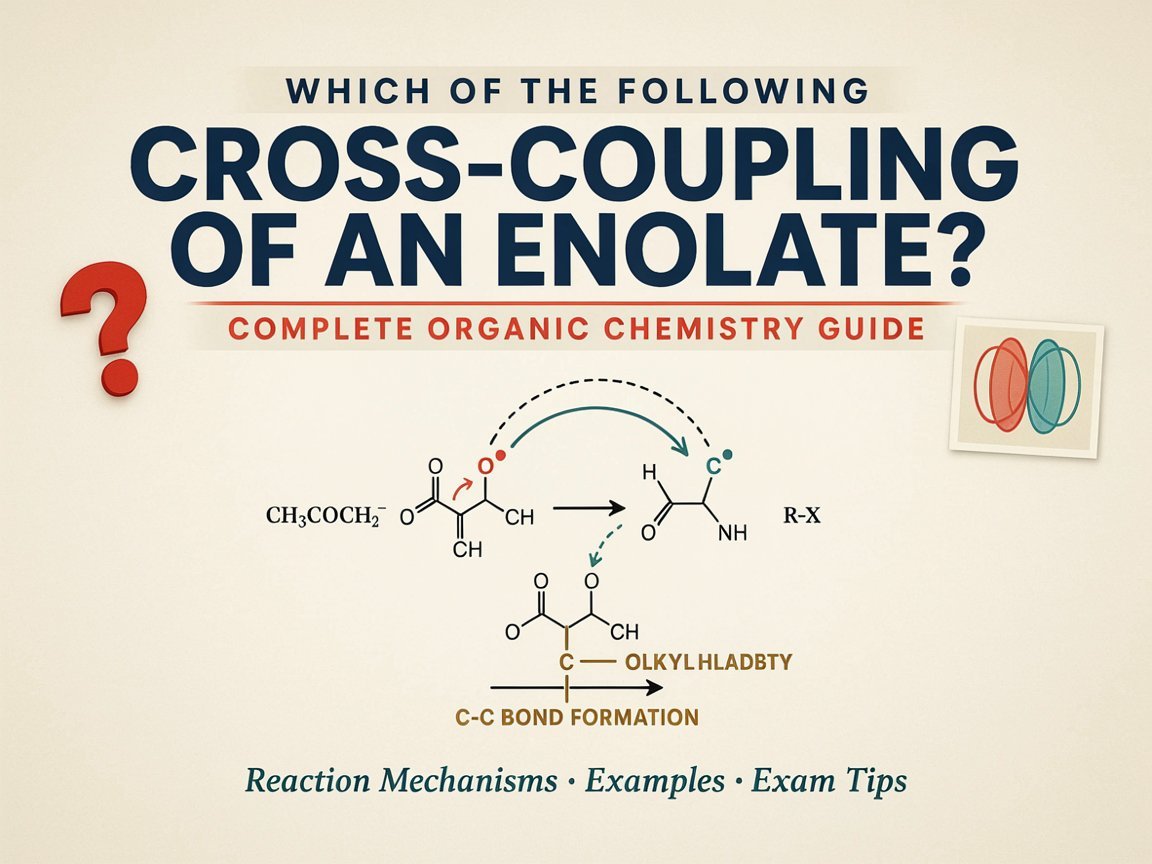
Which of the Following Cross Couplings of an Enolate?
Table of Contents
ToggleWhich of the Following Cross Couplings of an Enolate: Complete Guide to Reaction Mechanisms, Products & Exam Preparation
Introduction
which of the following cross couplings of an enolate is a commonly searched keyword among chemistry students, university learners, and competitive exam candidates studying organic chemistry. Enolate chemistry is one of the most important topics in carbon–carbon bond formation because enolates are highly reactive intermediates that participate in numerous synthetic reactions. Questions involving enolate cross-coupling frequently appear in chemistry quizzes, assignments, laboratory courses, and entrance examinations.
People searching for which of the following cross couplings of an enolate usually want to identify the correct answer to a chemistry multiple-choice question about enolate cross-coupling reactions. They are often looking for explanations of reaction mechanisms, correct coupling products, exam solutions, or study resources related to organic chemistry, especially for quizzes, assignments, or competitive exams.
In this article, we will explain which of the following cross couplings of an enolate, discuss the fundamentals of enolate chemistry, examine common cross-coupling reactions, understand reaction mechanisms, and provide study tips that help students solve exam questions confidently.
American Chemical Society (ACS)
Which of the Following Cross Couplings of an Enolate
The keyword which of the following cross couplings of an enolate usually appears in chemistry multiple-choice questions where students must identify the correct reaction, mechanism, catalyst, or product.
These questions often test knowledge of:
- Enolate formation
- Carbon–carbon bond formation
- Organic reaction mechanisms
- Palladium-catalyzed reactions
- Reaction selectivity
- Synthetic chemistry
- Product prediction
- Cross-coupling chemistry
Understanding these concepts makes answering examination questions much easier.
What Is an Enolate?
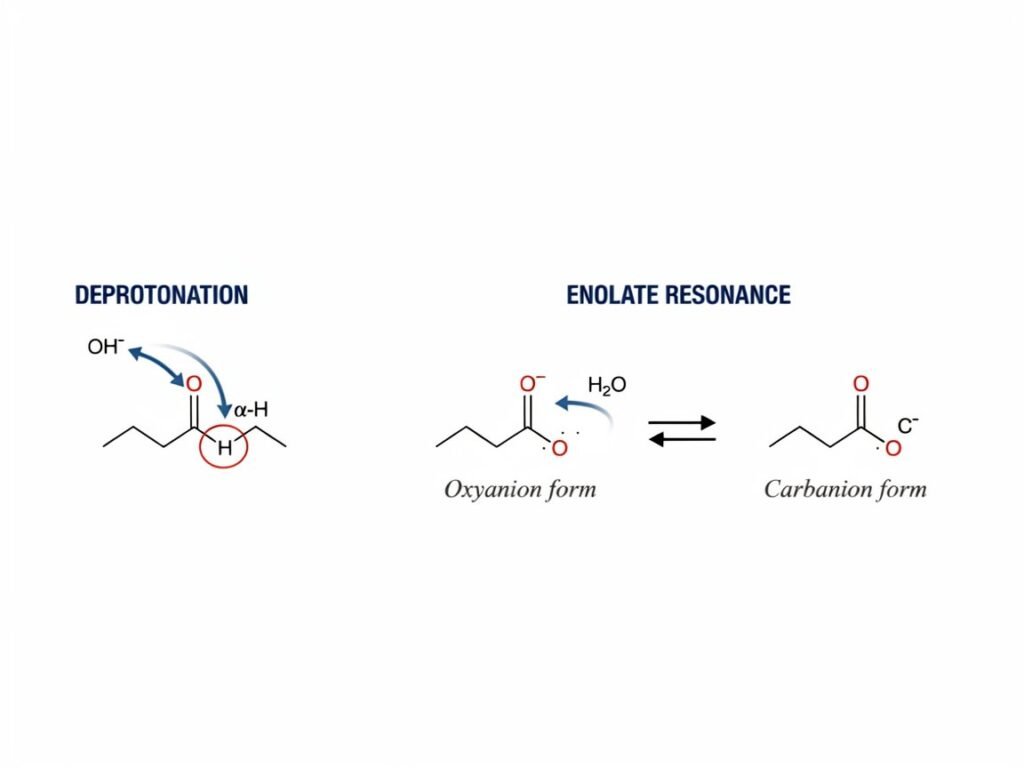
An enolate is a negatively charged intermediate formed when a hydrogen atom next to a carbonyl group is removed by a strong base.
Enolates are highly reactive because they contain:
- A negatively charged oxygen
- A nucleophilic alpha carbon
- Resonance stabilization
- High synthetic versatility
They are among the most important intermediates in organic chemistry.
ChemLibreTexts Organic Chemistry
Formation of an Enolate
Enolates are produced when a base removes an alpha hydrogen from:
- Ketones
- Aldehydes
- Esters
- Amides
- β-Dicarbonyl compounds
- LDA (Lithium Diisopropylamide)
- Sodium Hydride (NaH)
- Potassium tert-butoxide
- Sodium Ethoxide
The strength of the base influences enolate formation.
Why Enolates Are Important
Enolates are valuable because they help build larger molecules.
Applications include:
- Carbon–carbon bond formation
- Pharmaceutical synthesis
- Natural product synthesis
- Polymer chemistry
- Agrochemical production
- Fine chemical manufacturing
Many modern organic syntheses depend on enolate chemistry.
What Is Cross Coupling?
Cross coupling is a chemical reaction in which two different molecular fragments join together to form a new carbon–carbon bond.
Typically, cross-coupling reactions involve:
- Organometallic reagents
- Halides
- Transition metal catalysts
- Controlled reaction conditions
These reactions are widely used in modern organic synthesis.
Relationship Between Enolates and Cross Coupling
Enolates can participate in several cross-coupling reactions to produce complex organic molecules.
These reactions often involve:
- Palladium catalysts
- Nickel catalysts
- Copper catalysts
- Activated electrophiles
The objective is to create new carbon–carbon bonds efficiently.
Common Cross-Coupling Reactions Related to Enolates
Several well-known reactions are frequently discussed in organic chemistry.
Suzuki Coupling
Uses:
- Organoboron compounds
- Palladium catalyst
Applications:
- Pharmaceutical synthesis
- Fine chemicals
- Functionalized molecules
Negishi Coupling
Uses:
- Organozinc reagents
- Palladium catalyst
Known for:
- High selectivity
- Excellent yields
Silent Coupling
Uses:
- Organotin compounds
Advantages include:
- Broad substrate scope
- Mild reaction conditions
Kumada Coupling
- Grignard reagents
- Nickel or palladium catalysts
Often used for:
- Carbon–carbon bond formation
- Industrial synthesis
Heck Reaction
Although not always classified as direct enolate coupling, the Heck reaction is another important palladium-catalyzed reaction involving carbon–carbon bond formation.
Reaction Mechanism of Enolate Cross Coupling
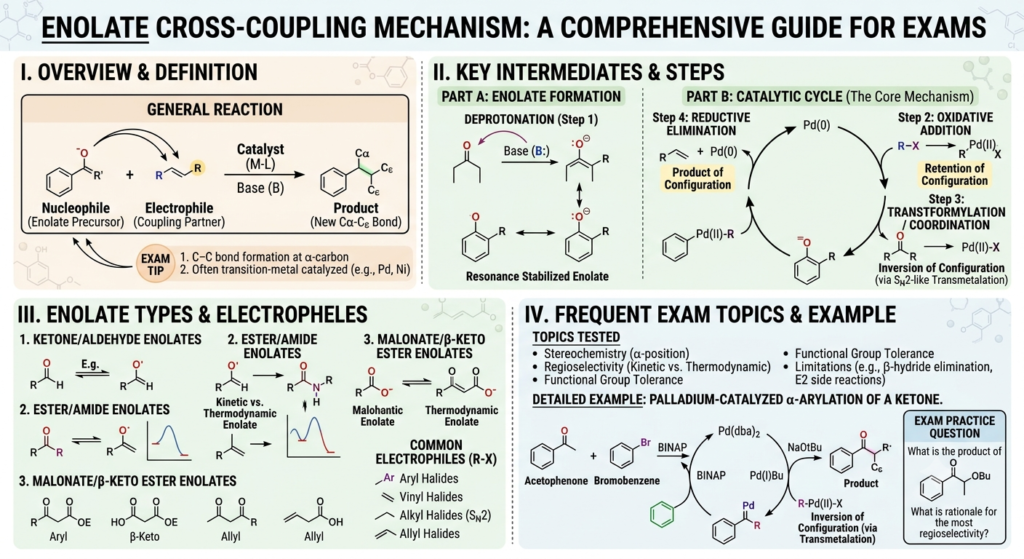
The mechanism generally involves several steps.
Step 1: Enolate Formation
A strong base removes an alpha hydrogen.
The enolate ion forms.
Step 2: Catalyst Activation
The transition metal catalyst becomes active.
Common catalysts include:
- Palladium
- Nickel
Step 3: Oxidative Addition
The catalyst inserts into the carbon–halogen bond.
This activates the electrophile.
Step 4: Transmetalation or Coupling
The enolate fragment transfers to the catalyst.
The new carbon–carbon bond begins forming.
Step 5: Reductive Elimination
The catalyst releases the final product.
The catalyst is regenerated.
The reaction cycle then repeats.
Products Formed During Enolate Coupling
Products depend on:
- Starting materials
- Catalyst
- Reaction conditions
- Electrophile
Possible products include:
- Ketones
- Esters
- Substituted carbonyl compounds
- Cyclic molecules
- Pharmaceutical intermediates
Predicting products is a common exam question.
Factors Affecting Cross-Coupling Reactions
Reaction efficiency depends on several variables.
Important factors include:
Catalyst Selection
The catalyst controls:
- Yield
- Selectivity
- Reaction speed
Base Choice
The base influences:
- Enolate formation
- Reaction stability
- Product distribution
Temperature
Temperature affects:
- Reaction rate
- Side reactions
- Product purity
Solvent
Common solvents include:
- THF
- DMF
- Toluene
- Dioxane
Proper solvent selection improves efficiency.
Why These Questions Appear in Exams
Chemistry instructors often include questions on enolate coupling because they test multiple concepts simultaneously.
Students demonstrate understanding of:
- Organic mechanisms
- Nucleophilic reactions
- Catalysis
- Carbon–carbon bond formation
- Product prediction
These are essential skills in advanced organic chemistry.
Common Multiple-Choice Question Topics
Questions often ask students to identify:
- Correct product
- Correct catalyst
- Strongest base
- Proper reaction conditions
- Reaction mechanism
- Intermediate structures
- Carbon–carbon bond formation
Practicing these questions improves exam performance.
Common Mistakes Students Make

Students frequently confuse:
- Enolates with enols
- Catalysts used in different coupling reactions
- Product structures
- Base selection
- Reaction mechanisms
Careful study reduces these errors.
Tips for Solving Enolate Cross-Coupling Questions
Students can improve by:
- Learning resonance structures
- Practicing reaction mechanisms
- Memorizing common catalysts
- Studying reaction conditions
- Drawing reaction pathways
- Reviewing product prediction exercises
Regular practice builds confidence.
Applications of Enolate Cross Coupling
These reactions are widely used in industry.
Applications include:
Pharmaceutical Manufacturing
Production of:
- Drug molecules
- Active pharmaceutical ingredients
- PubChem
Agricultural Chemicals
Preparation of:
- Herbicides
- Pesticides
- Plant growth regulators
Material Science
Synthesis of:
- Functional polymers
- Organic electronic materials
- Specialty chemicals
Academic Research
Researchers use enolate chemistry to:
- Develop new reactions
- Build complex molecules
- Improve synthetic efficiency
Advantages of Enolate Cross Coupling
Major advantages include:
- Efficient carbon–carbon bond formation
- High selectivity
- Broad substrate compatibility
- Mild reaction conditions
- Industrial applicability
- Excellent synthetic flexibility
These benefits explain why these reactions are widely studied.
Challenges in Enolate Chemistry
Despite its usefulness, challenges remain.
Examples include:
- Side reactions
- Product mixtures
- Catalyst sensitivity
- Moisture sensitivity
- Difficult substrate compatibility
Researchers continue improving these reactions.
Future of Enolate Cross Coupling

Modern chemistry continues to advance.
Future developments may include:
- Greener catalysts
- Sustainable reaction conditions
- AI-assisted reaction prediction
- Improved selectivity
- Faster synthesis methods
- Environmentally friendly solvents
Innovation continues expanding the possibilities of enolate chemistry.
Why Students Search “Which of the Following Cross Couplings of an Enolate”
Search demand remains high because students need which of the following cross couplings of an enolate?
- Quiz preparation
- Homework assistance
- Product prediction
- Mechanism explanations
- Competitive exam study
- Organic chemistry revision
- Laboratory understanding
This topic combines theoretical knowledge with practical applications.
Frequently Asked Questions
What is an enolate?
An enolate is a resonance-stabilized ion formed when a base removes an alpha hydrogen from a carbonyl compound.
What is cross coupling in organic chemistry?
Cross coupling is a reaction that joins two molecular fragments to create a new carbon–carbon bond, often using transition metal catalysts.
Why are enolate cross-coupling reactions important?
They are widely used to synthesize pharmaceuticals, natural products, agrochemicals, and advanced organic compounds.
Which catalysts are commonly used in enolate cross coupling?
Palladium and nickel catalysts are among the most common catalysts used in these reactions.
How can students prepare for questions about enolate cross coupling?
Students should practice reaction mechanisms, study catalyst functions, understand enolate formation, and solve product prediction problems regularly.
Final Thoughts
Understanding which of the following cross couplings of an enolate is essential for mastering advanced organic chemistry. These reactions play a vital role in carbon–carbon bond formation and are widely applied in pharmaceutical research, industrial chemistry, and academic laboratories. Because they frequently appear in quizzes, assignments, and competitive examinations, students who understand enolate formation, reaction mechanisms, catalyst selection, and product prediction are better prepared for both academic success and practical applications, which of the following cross couplings of an enolate.
By consistently reviewing reaction mechanisms, practicing multiple-choice questions, and understanding the principles behind enolate cross-coupling reactions, students can confidently solve complex organic chemistry problems and strengthen their overall knowledge of modern synthetic chemistry.